
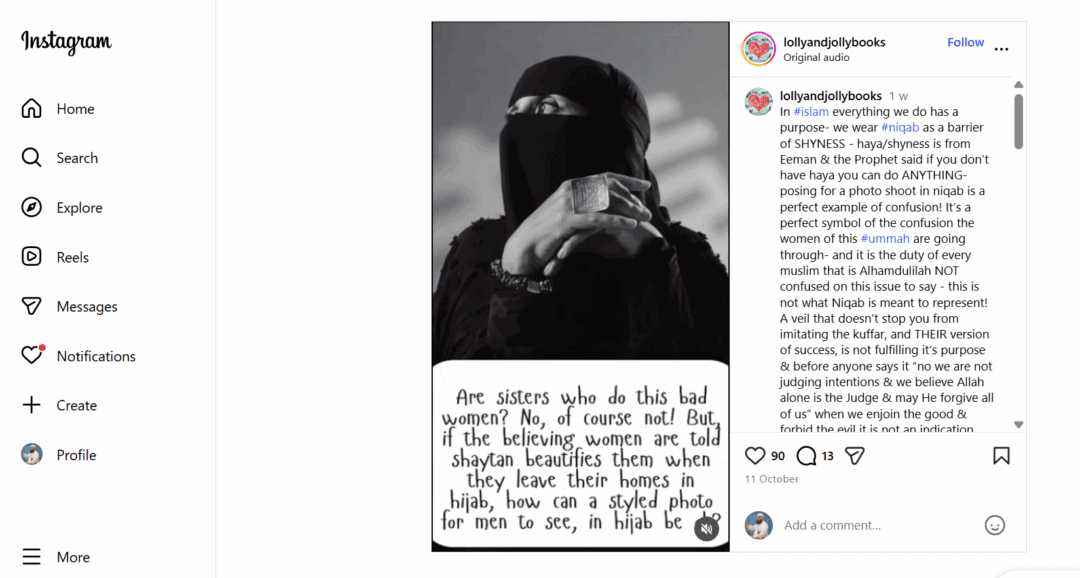
Recently, I stumbled upon an Instagram post by Um Yahya at Lolly & Jolly Books , fiercely calling out high-profile Niqaabi Muslim children’s story writer Sister Na’ima B. Robert for doing a photoshoot for a feature in a prestigious New York women’s fashion magazine, Auralis.

The author of the post, Um Yahya—also a writer—argues that it is wrong for Sister Na’ima to pose for glossy fashion magazines in a face veil (Niqaab), as such an act imitates non-Muslim behaviour. She also argues that it is an inappropriate way for Muslim women to seek worldly fame and, more importantly, that it goes against the very purpose of the face veil, which is to protect a Muslim woman’s modesty and maintain her shyness before the opposite sex.
Whether right or wrong, the post caused quite a stir online. It also made me question whether the public exposure of other Muslims on social media might, in reality, be a form of backbiting and therefore sinful in Islam.
Um Yahya argues that by calling out Sister Na’ima for the indecorous photoshoot, she is fulfilling her Islamic duty to enjoin the good and forbid the wrong (الأمر بالمعروف والنهي عن المنكر). She also claims that her intentions are not to insult or judge anyone, but rather that she feels duty-bound and seeks to protect young Muslim females from undue influences and to preserve Islam and its teachings.

Table of Contents
- How in Islam Does Talking About Others Turn Into Backbiting?
- When Backbiting (Ghibah غِيبة) Is Harmful and Sinful
- When Backbiting (Ghibah غِيبة) Is Neither Harmful Nor Sinful
- Permissibility of Calling Others Out on Social Media
- Enjoining the Good and Forbidding the Wrong
- Balancing Public Image & Private Correction in the Muslim Community
- Conclusion
- Useful References and Links
So, How in Islam Does Talking About Others Turn Into Backbiting?
In Islam, speaking about someone becomes backbiting (ghibah غِيبة) when, behind their back, we say something about them that they would dislike.
Prophet Muhammad ﷺ said:
“If what you say about him is true, then you have backbitten him. But if it is false, then you have slandered him.”
Allah ﷻ also says in the Holy Qur’an:
“O you who have believed, avoid much suspicion. Indeed, some suspicion is sin. And do not spy, nor backbite one another. Would one of you like to eat the flesh of his dead brother? You would detest it! And fear Allah; indeed, Allah is Accepting of repentance and Merciful.
So, for Allah ﷻ, backbiting another Muslim is akin to eating their flesh. For Prophet Muhammad ﷺ, it is about speaking the truth about someone behind their back in a way they would dislike.
When Backbiting (Ghibah غِيبة) Is Harmful and Sinful

Impermissible Backbiting
In Islam, backbiting occurs when you speak about someone who is not present in a way they would dislike. For example, you might be a company manager complaining to other workers about an employee:
“Oh, Mohammed’s late for work again. This guy’s terrible—so lazy and irresponsible.”
It may be true that Mohammed often arrives late, but the negative comment is, in fact, an act of backbiting. Mohammed would not like your remark made behind his back. It harms his reputation and serves no useful purpose.
This kind of speech targets his person or character and is therefore unproductive and sinful in Islam.
A better way to handle Mohammed’s lateness would be to focus on the issue rather than the person. For example, you could speak privately to Mohammed about his tardiness and later address all employees together, saying,
“Being late is not acceptable for any employee, so I’d like you all to come to work on time in future.”
Everyone knows the message is directed at Mohammed, but it avoids targeting his character. Therefore, it is constructive and free from sin.
Impermissible Backbiting – Other Examples
1. You are a jealous student and say to others, “Oh, Ahmed is terrible at Maths. He will never pass the exams.”
2. You dislike a certain girl and tell her friends, “Fatimah is always rude to people. She’s not a nice person.”
3. You complain to others, saying, “My boss is useless and hasn’t got a clue what he’s doing.”
In these examples, whether true (backbiting) or false (slander), such statements damage reputations, harm relationships, and destroy trust within the community. It would be better to remain silent or to speak privately with the individuals concerned, offering constructive feedback rather than public criticism.
When Backbiting (Ghibah غِيبة) Is Neither Harmful Nor Sinful

Permissible Backbiting
In Islam, speaking about someone’s actions is permissible if you intend to protect others or prevent harm in the community. Your words should focus on actions, not the person’s character.
For example, if you learn that a local Muslim store is selling spoiled food, you may say, “So-and-so is selling spoiled food. Don’t buy from him; it might make you sick.”
Here, your goal is to protect others, not to insult the storekeeper. This speech is permissible because it aims to prevent harm, not to shame.
Permissible Backbiting – Other Examples
1. You warn others about a contractor who uses poor materials and constructs unsafe buildings.
2. You warn people about someone selling counterfeit medicine.
3. You caution others about a reckless driver to ensure their safety.
In all these cases, you are not gossiping or judging someone’s character but warning others for their protection.
Permissibility of Calling Others Out on Social Media
Based on Prophet Muhammad’s ﷺ definition of backbiting and the Qur’anic warning in Surah Al-Ḥujurāt (49:12), I wondered whether Um Yahya’s criticism of Sister Na’ima posing for a fashion magazine in a face veil (Niqaab) might be backbiting.
The answer depends on intention and tone. If Um Yahya aims to shame, insult, or expose Sister Na’ima’s faults without due cause, it is backbiting (Ghibah). However, if she sincerely seeks to advise and protect others while speaking respectfully, it may be permissible.
The Instagram post includes photos of Sister Na’ima in various professional poses, arguing that these images misrepresent the purpose of the face veil (Niqaab), which is to maintain modesty. Um Yahya criticises the dress style and presentation but avoids attacking Sister Na’ima’s character. In fact, she acknowledges that Sister Na’ima is a good person and focuses only on the action.
For the post to be seen as sinful backbiting, three conditions must apply: 1. It must be said behind the person’s back, 2. the person must dislike it, and 3. it must be true. While the post meets the first two, the last element—truth—relates mostly to subjective opinion. Since Um Yahya does not insult or defame Sister Na’ima personally, it likely does not constitute sinful backbiting.
Enjoining the Good and Forbidding the Wrong
To justify her criticism, Um Yahya claims she is fulfilling her Islamic duty to enjoin good and forbid evil (الأمر بالمعروف والنهي عن المنكر), based on the verse:
“Let there be a group among you who call others to goodness, encourage what is good, and forbid what is evil, for it is they who will be successful.” (Surah Al-Imran, 3:104
In Islam, it is permissible to criticise actions publicly for guidance without resorting to personal insults. Such advice falls under the principle of enjoining good and forbidding evil, which is encouraged.
Balancing Public Image & Private Correction in the Muslim Community
The Auralis magazine features prominent businesswomen and innovators. By agreeing to appear in a face veil (Niqaab) in a glossy, high-profile publication, Sister Na’ima may have unintentionally opened herself to criticism from the Muslim community.
In my opinion, her decision was unwise. While the photos are not prohibited (Haram), they do contradict the essence of wearing the face veil (Niqaab). Perhaps she was tempted by the beneficial publicity.
However, Um Yahya’s intense online response treads a fine line between legitimate Islamic admonition and unnecessary public humiliation. Given the sensitivity of the matter, it would have been wiser and kinder to address Sister Na’ima privately. Public shaming often causes pain, division, and discord (Fitnah) within the Muslim community (Ummah).
Our beloved Prophet Muhammad ﷺ said:
“Whoever covers the faults of a Muslim, Allah will cover his faults in this world and the Hereafter.” (Sahih Muslim, Hadith 2590
Conclusion
In conclusion, talking about others becomes backbiting (Ghibah غِيبة) in Islam when people speak the truth about them in their absence in a way they would dislike. Even if we intend to correct or warn others, the manner, tone, and purpose of our words determine whether our speech is sinful or permissible.
Publicly calling out others on social media, as in the case of Um Yahya and Sister Na’ima, walks a fine line between sincere advice for Allah’s sake and harmful exposure of another’s faults. Perhaps envy or rivalry may also play a role—but Allah knows best.
True Islamic advice should be private, sincere, and compassionate—never humiliating or vindictive. It should aim to correct while preserving dignity. As Muslims, we must protect one another’s honour, for whoever conceals a believer’s fault, Allah ﷻ will conceal theirs in this world and the next.
Insha’Allah, Ameen.
Useful References and Links
The Book of Virtue, Enjoining Good Manners, & Joining of the Ties of Kinship– Sahih Muslim, Hadith 2589
The Holy Quran – Surah Al-Ḥujurāt 49:12
Quran.com Surah Al-Imran (3:104)
The Book of Virtue, Enjoining Good Manners, and Joining of the Ties of Kinship (Sahih Muslim, Hadith 2590)